እንዴት የተዘጋ ዳይ አንጥረኛ ይሰራል፡ ሂደት፣ ጥቅሞች እና ገደቦች?
Closed die forging is a metal-forming process used to produce shaped components by compressing heated metal between dies containing the required impression. Unlike casting, where molten metal is poured into a mold and solidifies into a shape, forging forms solid metal through controlled plastic deformation. The process can produce complex components with favorable grain flow, good mechanical properties, and relatively consistent dimensions, making it suitable for demanding industrial applications. In a typical የተዘጋ ዳይ መጭመቂያ operation, a billet or preform is heated to an appropriate forging temperature and placed between an upper and lower die. As the dies move together under a press or hammer, the metal flows into the die cavity. Excess material may be forced out through the flash land, helping generate the pressure required for cavity filling. Depending on the component geometry, several forming stages may be required before the final impression is completed. Closed die forging is widely used for components in automotive, energy, construction equipment, aerospace, industrial machinery, and other applications where strength and repeatability are important. However, it is not automatically the best manufacturing process for every part. Tooling investment, production volume, component size, material forgeability, geometry, and required tolerances all influence whether the process is economically and technically appropriate.
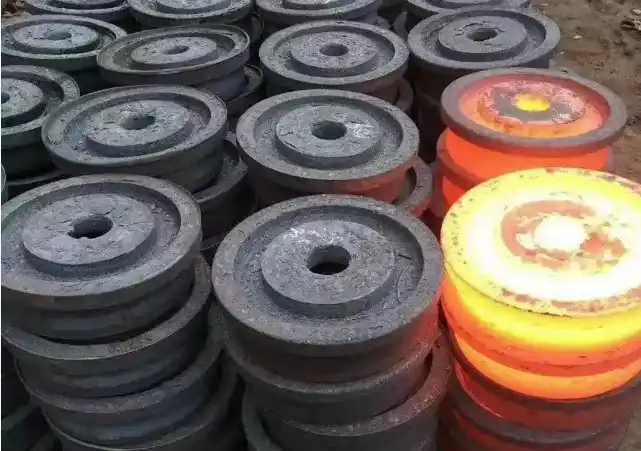
How Does the Closed Die Forging Process Work?
1. Billet selection, cutting, and preparation
The process starts with the selection of forging stock that matches the required material grade and component design. Common starting forms include round or square bars, although the appropriate stock depends on the forging equipment and part geometry.
The billet is cut to a controlled weight and length. Material quantity is important because the starting volume must be sufficient to fill the die cavity and, where applicable, provide the material required for flash. An undersized billet can lead to incomplete die filling, while excessive material can increase flash, forming load, trimming requirements, and material waste.
For production parts, billet preparation should also consider material cleanliness, surface condition, and dimensional consistency. Variations in billet weight or condition can affect material flow and contribute to process variation.
2. Heating to the appropriate forging temperature
After preparation, the billet is heated within a temperature range appropriate for the selected alloy. The objective is not simply to make the material “soft,” but to reduce its flow stress sufficiently for deformation while maintaining suitable metallurgical conditions.
Steel forgings, for example, are commonly processed at elevated temperatures, but the exact temperature range depends on the alloy and the forging sequence. Aluminum, titanium, nickel-based alloys, and other materials require different process windows.
Heating can be performed using gas furnaces, induction systems, or other industrial heating equipment. Temperature uniformity is especially important for larger cross-sections because an overheated surface and a relatively cold core can produce inconsistent deformation behavior.
Process engineers therefore consider heating rate, soak time, billet temperature, transfer time, and the temperature of the dies. Excessive heating can increase oxidation or scale formation, while insufficient temperature can make material flow more difficult and increase forging loads.
3. Die design and preform development
Die design is one of the most important engineering stages in የተዘጋ ዳይ መጭመቂያ. The die cavity must guide the material into the required geometry without creating excessive local deformation or unfavorable flow patterns.
For relatively simple components, the billet may proceed directly into a finishing impression. More complex components often require one or more performing stages. A blocker or intermediate impression redistributes the material before final forging so that the finishing die can be filled more effectively.
Engineers consider several factors during die development, including:
-
Parting-line location
-
ረቂቅ ማዕዘኖች
-
Fillet and corner radii
-
Material flow direction
-
Flash design
-
Die filling behavior
-
Expected forging load
-
የማሽን አበል
-
ህይወት ይሙት
-
የሚያስፈልጉ የልኬት መቻቻል
Computer-aided design and finite-element simulation can be used to evaluate material flow before production tooling is finalized. Simulation is particularly useful for identifying potential underfill, folding, excessive deformation, or areas where the forming load may exceed equipment capability.
4. Preforming and material redistribution
A preforming operation may be required when the final component contains ribs, bosses, flanges, deep sections, or significant variations in cross-section.
Instead of forcing the original billet directly into the final cavity, the preform distributes material closer to the final geometry. This reduces the amount of material movement required during the finishing operation and can improve die filling.
The design of the preform is closely connected to defect prevention. Poor material distribution can cause metal to flow around a feature instead of filling it or can cause the surface to fold back on itself. Proper preform development therefore contributes to both dimensional quality and structural integrity.
5. Final forging in the closed dies
During the final forging operation, the heated preform enters the finishing impression and is compressed between the dies. The applied force causes the metal to flow into the cavity and reproduce the geometry of the die.
The actual forging load is not a universal fixed value. It depends on material strength at the forging temperature, part geometry, deformation amount, friction, die design, equipment type, and other process conditions.
In many conventional closed-die processes, excess material flows toward the flash area. Flash is not simply unwanted waste. Properly designed flash can provide resistance to outward material flow, increasing pressure inside the die cavity and helping fill detailed features. ASM references this function of flash as an important part of closed-die forging behavior.
Depending on the part, the forging may require multiple hammer blows or press strokes. Some components may also pass through several impressions before reaching the final shape.
6. Flash trimming and post-forging operations
After forging, excess flash is normally removed in a trimming operation. The trimming method depends on component geometry, material, temperature, and production requirements.
The forged component may then require additional operations such as
-
የሙቀት ህክምና
-
ቀጥ ያለ መንገድ
-
Descaling or shot blasting
-
የማሽን
-
ቁፋሮ
-
ወፍጮ ይፈጫሉ;
-
ማለስለስ; ማጽዳት; ማስተካከል
-
ልኬት ፍተሻ
-
አጥፊ ሙከራ
ስለዚህ, የተዘጋ ዳይ መጭመቂያ should generally be viewed as one stage within a complete manufacturing route rather than an isolated operation that always produces a finished part directly from the die.
What Are the Main Advantages of Closed Die Forging?
Improved mechanical performance and controlled grain flow
One of the major reasons manufacturers select forging is the ability to control material deformation and grain flow through the component geometry.
Compared with many subtractive manufacturing routes, forging can produce a favorable grain-flow pattern that follows the general shape of the component. This can be valuable for parts subjected to repeated loading, impact, or high mechanical stress.
However, the final mechanical properties depend on more than the forging operation itself. Alloy composition, forging reduction, temperature history, cooling rate, heat treatment, and subsequent machining all contribute to the final properties.
Complex shapes with relatively efficient material use
Closed dies allow manufacturers to produce geometries that would be difficult to create economically through simple open-die operations. Ribs, bosses, flanges, and other three-dimensional features can often be incorporated into the forged geometry.
Because the forged component can be produced relatively close to its final geometry, machining requirements may be reduced compared with starting from a large block and removing most of the unwanted material.
This does not mean that every closed-die forging is automatically a near-net-shape component. The amount of subsequent machining depends on the required tolerances, surface finish, geometry, and application.
Good repeatability for production runs
Once the tooling, material preparation, heating cycle, and forging sequence have been validated, closed die forging can provide good production repeatability.
This is particularly valuable for components manufactured in medium- or high-volume quantities. Consistent dies and controlled process parameters allow manufacturers to reproduce the same basic geometry across production batches.
For OEM applications, repeatability can also simplify downstream machining and assembly because the incoming forgings have a more predictable dimensional condition.
Lower unit cost at suitable production volumes
The economics of closed die forging depend heavily on production volume.
Tooling and engineering costs can be significant at the beginning of a project. However, these fixed costs can be distributed across a larger number of components as production volume increases.
For high-volume programs, the combination of repeatable production, relatively efficient material utilization, and reduced machining can make closed die forging economically attractive.
For low-volume or frequently changing designs, however, the tooling investment may outweigh these advantages. A proper cost comparison should therefore consider the entire manufacturing route rather than comparing the forging price with the raw material price alone.
What Are the Limitations of Closed Die Forging?
Upfront tooling and engineering investment
Custom dies are a major consideration when evaluating closed die forging. Dies must withstand repeated mechanical loading and elevated temperatures while maintaining the required cavity geometry.
Tooling development may involve:
-
የዳይ ንድፍ
-
የቁስ ምርጫ
-
CNC ማሽነሪ
-
የሙቀት ህክምና
-
የወለል አጨራረስ
-
Trial forging
-
የዳይ ማሻሻያ
-
የሂደት ማረጋገጫ
If the component design changes substantially after tooling has been manufactured, additional tooling work may be necessary.
This is why annual demand, expected product life, design stability, and tooling amortization should be evaluated before selecting the process.
Part size and equipment capacity
Closed die forging can accommodate a broad range of component sizes, but the practical limit depends on available forging equipment, die dimensions, handling systems, material, and required forming load.
Very large components may require specialized forging equipment, larger dies, and more extensive material handling infrastructure. For such applications, open-die forging or other manufacturing methods may be more appropriate.
At the other end of the scale, small precision components can also require specialized equipment and tooling if extremely tight tolerances or complex details are involved.
The correct question is therefore not simply whether a part is “too large” or “too small,” but whether its dimensions and forming requirements are compatible with the available equipment and process capability.
የጂኦሜትሪክ ገደቦች
የተዘጋ ዳይ መፈልፈያ can produce complex shapes, but it still has geometric limitations.
Very deep cavities, sharp internal corners, severe thickness changes, and certain undercuts can create difficult material-flow conditions. Designers may need to modify the geometry by adding appropriate radii, draft, or material transitions.
A component designed primarily for machining may not be directly suitable for forging. Design-for-forging should be considered early in product development so that the geometry supports reliable material flow and reasonable die life.
Material flow and forging defects
Material-flow control is another important challenge.
Common closed-die forging defects include underfill, laps, folds, cold shuts, die mismatch, cracks, and surface-related defects. Their causes vary, but process temperature, billet volume, preform geometry, die design, lubrication, alignment, and deformation conditions can all influence defect formation.
Underfill occurs when the metal does not completely fill a region of the die cavity. It can result in incomplete ribs, rounded corners, or missing details.
Laps and folds occur when material folds over itself instead of following a controlled flow path. They are particularly associated with unfavorable die geometry, sharp transitions, poor preform design, or unsuitable material distribution.
Cold shuts are related to the meeting and folding of metal surfaces without adequate bonding. They should not simply be described as a result of rapid cooling; local flow behavior, temperature, geometry, and friction can all contribute.
Die mismatch can occur when the upper and lower die halves are not correctly aligned. This may produce an offset at the parting line and can create dimensional or machining problems.
Because these defects can affect structural integrity and dimensional quality, production programs should establish appropriate inspection and process-control procedures.
How Can Manufacturers Improve Closed Die Forging Quality?
Control billet temperature and transfer time.
Temperature control should be maintained from heating through forging. The billet can lose heat during transfer from the furnace to the forging equipment, especially when the transfer distance is long or the process cycle is slow.
Consistent heating and controlled transfer help maintain predictable material flow.
Optimize preform and die geometry.
A well-designed preform can significantly reduce unnecessary material movement during final forging. Engineers should evaluate areas such as ribs, webs, bosses, fillets, and transitions where flow may become unstable.
Finite-element simulation can help identify potential underfill and folding before production trials. Research on hot-die forging has also demonstrated the value of numerical simulation for identifying fold-prone regions and evaluating alternative tool arrangements.
Maintain die condition and alignment.
Die wear can gradually change cavity dimensions and affect part consistency. Alignment is equally important because a mismatch between die halves can create dimensional variation.
Routine die inspection, maintenance, and controlled setup procedures should therefore form part of the production plan.
Establish inspection according to the application.
Inspection requirements should be based on the material, geometry, customer specification, and service conditions.
Depending on the component, manufacturers may use dimensional inspection, hardness testing, metallographic examination, magnetic particle inspection, ultrasonic testing, or other applicable methods.
Critical components should have clearly defined acceptance criteria rather than relying only on visual inspection.
መደምደሚያ
Closed die forging is a controlled metal-forming process that uses shaped dies to transform heated billets or preforms into engineered components. Its main advantages include favorable grain flow, strong mechanical performance, repeatable geometry, and the ability to produce relatively complex shapes with less machining than some alternative manufacturing routes.
However, the process also involves important limitations. Tooling requires an upfront investment, component geometry must support reliable material flow, and equipment capacity places practical limits on part size and forming requirements. Defects such as underfill, laps, folds, cold shuts, and die mismatch must also be controlled through appropriate billet preparation, temperature management, die design, process parameters, and inspection.
በእነዚህ ምክንያቶች የተዘጋ ዳይ መጭመቂያ is best evaluated as part of a complete manufacturing strategy. When production volume, material, geometry, performance requirements, and tooling economics are aligned, it can provide an effective combination of structural performance and production efficiency.
Shaanxi Welong Int'l Supply Chain Mgt Co., Ltd., established in 2001, provides customized metal components for customers across multiple industrial sectors. The company offers forging, casting, and machining capabilities and holds ISO 9001:2015 and API-7-1 certifications. Its engineering and production teams support projects involving process development, quality control, and international delivery.
For an OEM or industrial forging project, customers can provide a drawing, 3D model, material specification, target quantity, and required tolerances for an initial manufacturing assessment. This information allows the team to evaluate the feasibility of the forging route, identify potential tooling or process considerations, and develop a production solution based on the actual component requirements rather than a generic process assumption. For top-quality metal components and exceptional service, contact us at info@welongpost.com.
በየጥ
1: በተዘጋ የዳይ ፎርጂንግ እና በክፍት የዳይ ፎርጂንግ መካከል ያለው ዋና ልዩነት ምንድነው?
Closed die forging uses two or more dies that completely enclose the workpiece, allowing for more precise shaping, while open die forging uses flat or simple contoured dies, offering more flexibility but less precision.
2: በተዘጉ የዳይ ፎርጂንግ ውስጥ ምን አይነት ቁሳቁሶች ጥቅም ላይ ሊውሉ ይችላሉ?
Closed die forging can be used with a wide range of metals, including carbon steel, alloy steel, stainless steel, aluminum alloys, titanium, and copper alloys.
3: የተዘጉ የዳይ ፎርጂንግ የአንድን ክፍል ሜካኒካል ባህሪያት እንዴት ያሻሽላል?
The intense pressure applied during forging refines the grain structure of the metal, leading to improved strength, toughness, and fatigue resistance compared to cast or machined parts.
4: የተዘጉ የዳይ ፎርጂንግ ለአነስተኛ የምርት ሩጫዎች ተስማሚ ነው?
Generally, closed die forging is more cost-effective for large production runs due to high initial tooling costs. For small runs, other methods might be more economical.
ማጣቀሻዎች
1. ስሚዝ, ጄ (2018). የላቁ የማምረቻ ሂደቶች፡ ዝግ ዳይ መፈልፈያ ቴክኒኮች። የቁሳቁስ ማቀነባበሪያ ቴክኖሎጂ ጆርናል, 56 (3), 245-260.
2. ጆንሰን፣ ኤ.፣ እና ብራውን፣ ቲ. (2019)። በአውቶሞቲቭ ኢንዱስትሪ ውስጥ የፎርጂንግ ዘዴዎች ንፅፅር ትንተና። የሜካኒካል ምህንድስና ዓለም አቀፍ ጆርናል, 42 (2), 178-195.
3. ዊሊያምስ, አር. (2020). የተዘጉ የሞት መፈልፈያ የብረታ ብረት ገጽታዎች. የቁሳቁስ ሳይንስ እና ምህንድስና፡ A, 715, 300-315.
4. ሊ, ኤስ, እና ፓርክ, K. (2017). የተጠናቀቀ ኤለመንትን ትንታኔን በመጠቀም በተዘጋ ዳይ ፎርጂንግ ውስጥ የዲ ዲዛይን ማመቻቸት። የማምረቻ ሂደቶች ጆርናል, 28, 410-425.
5. ቶምፕሰን, ኢ (2021). ለከፍተኛ-ጥራዝ ምርት በተዘጋ ዳይ ፎርጂንግ ውስጥ ያለው ኢኮኖሚያዊ ግምት። የኢንዱስትሪ ምህንድስና እና አስተዳደር ስርዓቶች, 20 (1), 55-70.
6. ጋርሲያ፣ ኤም.፣ እና ሮድሪጌዝ፣ ኤል. (2019)። በዝግ ዳይ ፎርጂንግ ውስጥ ያሉ እድገቶች፡ የመጠን እና የቅርጽ ገደቦችን ማሸነፍ። ፕሮሴዲያ ማምረት, 35, 890-905.

Share your inquiry, get the quotation accordingly!

ቻይና WELONG - በብረታ ብረት መፍትሄዎች ውስጥ የእርስዎ ታማኝ አጋር

